FRANCE
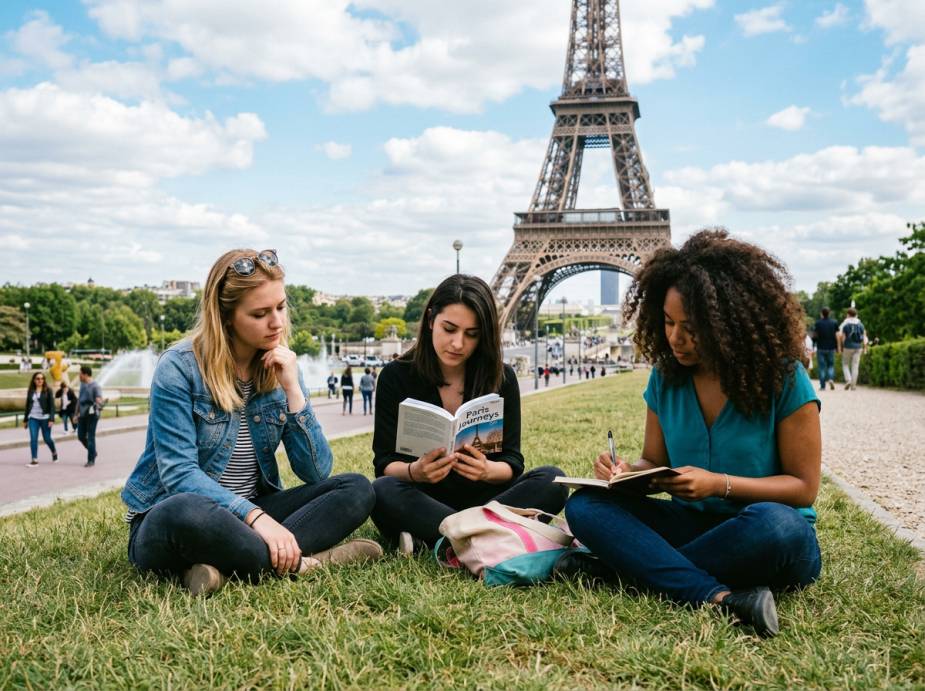
France is a country where public education remains among the most affordable in the world, even for foreigners, while the teaching — especially in engineering, business, art and the humanities — enjoys global recognition. People come here not only for a prestigious degree, but to learn French, for the cultural heritage and for a distinctive way of life. In 2025 France welcomed around 430,000 international students — the fifth-highest figure in the world, after the USA, the United Kingdom, Australia and Germany.
What people usually come to study
For school students. French private boarding schools are mostly Catholic institutions with a long history, set in the countryside or in small towns. They are marketed abroad far less than their Swiss or British counterparts, but they offer a very high standard of education following the French curriculum (the school-leaving diploma is the Baccalauréat). Some also run bilingual French–English programmes. Foreign pupils usually need French at B1–B2 level, or take an intensive language course before starting. Only a small number of boarding schools actively work with foreigners — roughly 30–40 across the country. Note: for children under 18, France often requires guardianship if the school does not take on that role itself.
For students. This is where the main interest lies. France has a dual higher education system: state universities (universités) and the grandes écoles. The state universities (more than 70) offer almost free tuition and a broad range of subjects. The grandes écoles are elite engineering schools (Polytechnique, Centrale, Mines), business schools (HEC, ESSEC, ESCP) and higher teacher-training schools (ENS). Entry is by competitive examination after two years of preparatory classes, and they are considerably more expensive, but their diplomas are worth their weight in gold. The most popular fields among foreigners are business and management (40% of international students), engineering and technology (25%), the humanities, art and design, and hospitality management. In 2025 the largest sources of international students were Morocco, Algeria, China, Tunisia, Italy, Spain and Germany, with around 5,000–7,000 from Russia (mostly at Master's level).
Features of studying
Secondary education. Boarding schools teach in French, with bilingual programmes available. The school day starts at 8:30 and ends at 17:00, followed by sport, clubs and supervised study. Many schools require a uniform. Residential life is overseen by house staff (surveillants). Foreign pupils are offered courses in French as a foreign language (FLE), the cost of which is often included in the overall fee.
Higher education. State universities follow the Bologna system: a Bachelor's (Licence) takes 3 years (180 ECTS credits), a Master's (Master) 2 years (120 credits) and a doctorate (Doctorat) 3 years. Teaching is predominantly in French, but since 2020 a growing number of Master's programmes have been offered in English (in business, engineering and digital technology). Studying at a state university is very cheap, though the French-language requirements are high (usually B2/C1 for a Bachelor's). At the grandes écoles, tuition is fee-paying (from 12,000 to 25,000 euros a year), but the diplomas give direct access to top employers and most programmes are in English. The academic year begins in September, and Master's admission often runs through the MonMaster or Campus France platform.

Visa requirements
Citizens of non-EU countries need a long-stay student visa, the VLS-TS (Visa de long séjour valant titre de séjour), to study for more than 90 days. The procedure is mandatory and, for many countries, includes a Campus France stage.
Stage 1: Campus France. Almost all foreigners (including those from Russia) must register on the Campus France platform, complete a questionnaire, pay a fee and attend an interview. The aim is to confirm your academic plan and language level; without Campus France approval, no visa will be issued. The fee ranges from 50 to 150 euros depending on the country, and processing takes 3–6 weeks.
Stage 2: Visa application at the embassy. Once Campus France has approved you, you submit your application for the VLS-TS visa.
Main requirements:
- Confirmation of enrolment (or pre-registration) at a French university
- Proof of funds: at least 615 euros a month for the whole intended period (around 7,380 euros a year). In practice, you are advised to show 800–1,000 euros a month.
- Medical insurance (can be arranged in France after arrival)
- A criminal record certificate from your country of residence (not always required)
- A passport valid for at least the full period of study
Cost and timescales: The consular fee is 99 euros, plus a biometrics fee of 25–50 euros depending on the embassy. Processing can take 4–12 weeks. After arriving in France, you register with the migration service online (validation du VLS-TS) and pay a fee of 50 euros. Within 3 months you must apply for a plastic residence permit card (titre de séjour étudiant), valid until the end of your studies.
Pros and cons
Pros:
- Remarkably low tuition fees for foreigners at state universities (2,770–3,770 euros a year).
- Education of the very highest quality at the grandes écoles, in engineering and in business.
- French degrees are recognised worldwide, especially in Europe, Africa and Canada.
- A large number of Master's programmes in English (more than 1,500).
- A rare chance to learn French to near-native level, which gives a real competitive edge.
- CAF housing subsidies, which lower your rent.
- The option to stay for 2 years after your studies to look for work.
- Affordable student healthcare (basic cover is free, supplementary insurance 100–300 euros a year).
- A country with a rich culture, excellent transport links and a varied climate.
Cons:
- Language barrier: for a Bachelor's, French at B2–C1 is all but essential. Without it, daily life (doctors, banks, renting) is difficult.
- Heavy bureaucracy: Campus France, long visa processing, then VLS-TS validation, then the titre de séjour — it takes months and a good deal of patience.
- The high cost of living in Paris and a shortage of housing. Even with subsidies, finding a studio for 800 euros in Paris is a real stroke of luck.
- Competition for CROUS places is fierce; many students live in private residences or shared flats.
- State universities carry less prestige than the grandes écoles, and getting into a grande école is hard (preparatory classes, stiff competition).
- Quality among state universities varies widely: there are outstanding ones (the Sorbonne, Paris-Saclay, Strasbourg, Lyon) and weaker ones.
|
In the French higher education system, there is no single national ranking comparable to the UK's Complete University Guide or the US's U.S. News. Instead, it is customary to rely on authoritative global rankings, where the country traditionally performs well, as well as on specialised rankings, for example, for business schools. Therefore, the basis for the national top here is the QS World University Rankings 2026 — as the most widely cited in the world and providing a clear picture of the international reputation of universities. In 2026, four French universities entered the QS top 100, confirming the country's strong position on the global education stage. For a more complete picture, in addition to QS positions, we have also included each university's place in the THE World University Rankings 2026, which emphasises research productivity, allowing universities to be assessed from two different perspectives. Below is the Top 10 universities in France according to the QS World University Rankings 2026. |
|||
| Rank (QS 2026, France) | University | QS 2026 (World) | THE 2026 (World) |
|---|---|---|---|
| 1 | Université PSL (Paris Sciences & Lettres) | 28 | 48 |
| 2 | Institut Polytechnique de Paris | 41 | =68 |
| 3 | Université Paris-Saclay | 70 | =68 |
| 4 | Sorbonne Université | 72 | no data |
| 5 | École Normale Supérieure de Lyon | 205 | 301–350 |
| 6 | Université Paris 1 Panthéon-Sorbonne | 257 | ~500 (estimate) |
| 7 | Université Paris Cité | 300 | ~350 (estimate) |
| 8 | Université Grenoble Alpes | 321 | ~400 (estimate) |
| 9 | Sciences Po Paris | 367 | ~400 (estimate) |
| 10 | INSA Lyon (National Institute of Applied Sciences) | 406 | 801–1000 |
|
In the French secondary education system, there is no single national ranking comparable to the British one. Instead, leading media outlets (Le Parisien, Le Figaro, L'Étudiant) publish their own annual rankings based on data from the Ministry of National Education. A key feature of the French approach is the "added value" indicator (valeur ajoutée), which assesses how much a school improves student outcomes compared to their starting level, allowing institutions with different student profiles to be compared fairly. The Le Parisien ranking, based on the 2025 baccalaureate results, covers over 2,260 schools and is considered one of the most authoritative. Below is the Top 10 lycées in France according to Le Parisien / Aujourd'hui en France (2026). |
||||
| Rank | Lycée | City | Type | Le Parisien Score |
|---|---|---|---|---|
| 1 | Lycée Charles de Foucauld | Paris (18th arrondissement) | Private | 16.77 |
| 2 | Lycée international de Grenoble | Grenoble | Public | 16.71 |
| 3 | Lycée Louis‑le‑Grand | Paris (5th arrondissement) | Public | 16.50 |
| 4 | Lycée international de l'Est parisien | Noisy‑le‑Grand | Public | 16.49 |
| 5 | Lycée international des Pontonniers | Strasbourg | Public | 16.45 |
| 6 | Lycée général et technologique Vaugelas | Chambéry | Public | 16.42 |
| 7 | Lycée Claude‑Monet | Paris (13th arrondissement) | Public | 16.39 |
| 8 | Lycée Charlemagne | Paris (4th arrondissement) | Public | 16.09 |
| 9 | Lycée Condorcet | Paris (9th arrondissement) | Public | 16.07 |
| 10 | Lycée François‑Rabelais | Paris (18th arrondissement) | Public | 15.95 |