HOST FAMILY
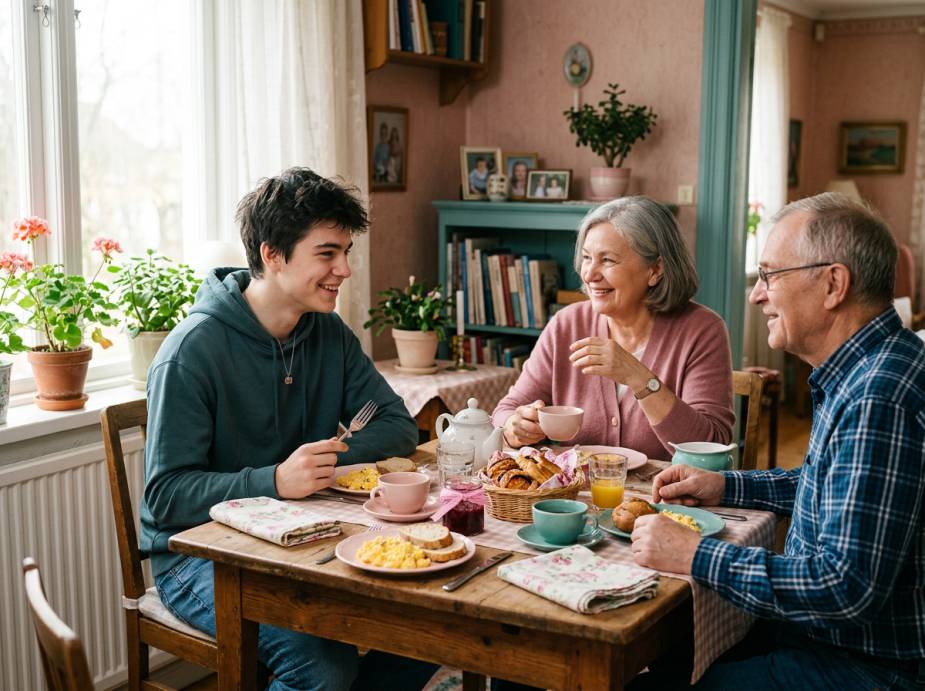
Living with a host family means staying with local residents — often older people who are happy to welcome a student from abroad. You get your own room, the use of the kitchen and living room, and usually breakfast and dinner. It is the gentlest way to immerse yourself in a new culture and pick up the language without endless cramming.
Who lives with host families?
Mostly schoolchildren aged 10 to 17 on language holidays or exchange programmes, along with adult students on short courses (2–8 weeks). On programmes such as a «language camp» or a «semester at a school abroad», up to 40% of children choose to live with a family. Adults are fewer — around 20% — as many find it awkward to fit in with someone else’s routine. The most popular countries for family stays are the United Kingdom, Ireland, Malta, Germany, the USA and Canada.
What is daily life like?
You have your own room — usually a single, sometimes (if you travel as a pair) a double. The bathroom is shared with the family; a separate one for the guest is rare. You may use the kitchen, though usually with conditions (not at any time, and not everything is fair game). Laundry is either done for you once a week or left for you to do on a schedule. Meals are most often half-board (breakfast and dinner) or full board (three times a day), and adults sometimes take breakfast only. The family decides when breakfast, lunch and dinner are served, and you have to adapt. If you come home late, dinner is reheated or left in the fridge. The biggest difference from other options is the rules: the family may ask you not to play loud music after 22:00, not to invite guests round without asking, not to occupy the bathroom for more than 15 minutes, and to turn off the lights when you leave the house. For some these are trifles; for others, unbearable control. But you speak the local language at breakfast, at dinner and simply in the hallway — and that brings more progress than any lesson.
The pros. Full immersion in the language and culture — you learn how ordinary people live, what they eat and what their habits are. It is safe, especially for children and teenagers, who are looked after by the family. There is no need to cook for yourself, which saves a great deal of time and energy (and money, compared with eating out). Adaptation is gentle: you are not alone in a foreign country, and there is always someone to tell you where to buy a travel pass or how to call a doctor. It is also often the cheapest option, after a dormitory with shared facilities.
The cons. Little freedom — you can’t come home at three in the morning, you can’t bring friends round, and sometimes you even have to shower on a schedule. You also depend on the family’s mood: if they are out of sorts or quarrelling, you feel uncomfortable too. It is something of a lottery — you may end up with a wonderful family, or an indifferent or rather odd one. And you don’t choose the food: if you dislike fish but it is served three times a week, you will have to put up with it. One more thing — language practice is not guaranteed, as some families barely talk to their guest, switch on the TV and retreat to their rooms.
What is interesting in different countries.
- United Kingdom. Families are strictly vetted — a police certificate, an interview, sometimes a home visit. The British are known for their rules: quiet after 22:00, lunch at one o’clock sharp, tea at five. But they are polite and unobtrusive. Many live in Victorian houses with small rooms and high ceilings. In London the room may be tiny and the family not well off; in the provinces, more spacious and warmer.
- Germany. Germans are punctual and love order. You will be taught to sort your rubbish, keep quiet after 22:00 and take off your shoes in the hallway. But they also give you space — they won’t breathe down your neck. The family often has children roughly your age, so you will fit in quickly. Many live in flats rather than houses. A popular format is the Gastfamilie for school exchanges, run by specialist organisations.
- Spain and Italy. Here families are very hospitable, but noisy. They dine late — at 21–22 hours — and may invite you to Sunday lunch with grandmothers and uncles. They don’t expect perfect punctuality, but they do expect you to join in family celebrations. The houses are often cold in winter (no central heating), but in summer the balconies and courtyards are yours to enjoy. Even if your Italian or Spanish is poor, the family will talk to you anyway — energetically and with plenty of gestures.
- France. French families are more formal. It matters to say hello when you come in, to say «merci» after every meal and not to be late for dinner. The room may be very small (the French don’t build huge houses), but you will be taught how to eat cheese and drink wine properly (if you are of age). Families often live in apartment blocks in the cities. Language practice is guaranteed, because the French won’t switch to English — even if you barely understand.
- USA and Canada. American families usually live in the suburbs, in detached houses. You will have your own room, often with its own bathroom. A car is almost essential — the family will drive you to school or the bus stop. Americans are more open and talkative than Europeans. There are downsides, though: the diet may run to ready meals and fast food, and the rules — being home by a set hour — apply even to 18-year-olds.
Who is it right for?
Children aged 10 to 17 going on language courses or to a school on exchange — this is almost the ideal option, combining supervision, language and gentle adaptation. Adults who want to actually start speaking the language in a short time (2–4 weeks) and aren’t put off by a few restrictions. It is not right for those who value their freedom and aren’t ready to fit in with someone else’s routine, nor for people with severe food allergies or strict diets, which a family may not be able to cater for.
A non-obvious fact. Many people fear that staying with a strange family will be uncomfortable, but research shows that students living with host families progress in the language two to three times faster than those in a dormitory. Even if the family isn’t very talkative, the simple things — breakfast, dinner, the TV in the local language — provide constant background exposure that the brain absorbs automatically. It also happens that families become friends for life, coming to weddings and standing as godparents to children. That is a different level altogether from simply renting a room.