RESIDENCE (HALL OF RESIDENCE)
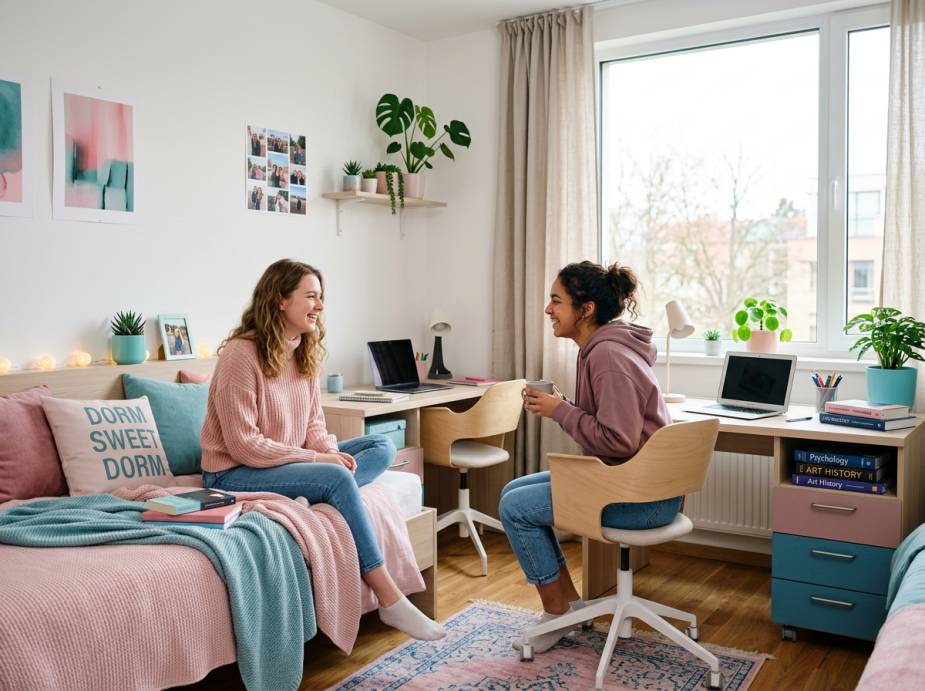
A residence is essentially a student hall. It usually belongs to a university, a language school or a private company, and it is the most common choice for students aged 17 and over, as well as for adults. If a boarding school is about childhood and discipline, a residence is about youth, socialising and your first taste of independent living.
Who lives there?
Mostly students on language courses (aged 18 to 30), students on preparatory programmes (Foundation, Pathway) and university students. Between 20 and 80% of first-year students live in university halls — in the USA, for instance, the figure is over 80%. In Europe the numbers are more modest: in Germany only 13% of students live in halls, simply because there aren't enough of them, so the rest rent rooms. On short language courses (2–4 weeks), though, residences are one of the most popular options — up to 40% of students choose them.
What is life like there?
Rooms take between one and six people; the more people, the cheaper it is. Budget options have bunk beds, while pricier ones have ordinary beds. The shower and toilet are either in the room (en suite) or shared on the floor. Along the corridor there is a kitchen (shared between 5–15 rooms), a lounge with sofas and a TV, and sometimes a table-tennis table. The laundry is usually in the basement or on the ground floor, and the washing machines are coin-operated (1–3 euros per cycle). Wi-Fi is available throughout. Supervision is minimal: a warden may sit at reception, with security at night, but no one checks whether you came back at two in the morning and no one looks into your room. Students take care of their own cleaning, laundry and food shopping (if there is no canteen). Some residences have a shared canteen, in which case meals are included — but more often there isn't one, just a kitchen for cooking your own.
Advantages. A handy location — you can usually walk to your school or university. A social life — with neighbours from different countries it's easy to make friends. You learn independence — doing laundry, cooking, budgeting. And you avoid the rental agreement and deposit you'd face with a flat. Residences often lay on shared activities too — film nights, language clubs, excursions.
Disadvantages. Little personal space — even in a single room you constantly hear your neighbours. Shared kitchens can be dirty, as not everyone washes up after themselves. Noise at night — someone is celebrating a birthday, someone is watching a film at full volume. No oversight — if you lack self-discipline, it's easy to let your studies slide. And one more thing: some residences have very strict rules (no guests after 10 p.m., for example), which annoys older students.
What stands out in different countries
- Germany and Austria. Here halls of residence (Wohnheim) are often built as whole neighbourhoods — «student villages» — with their own shop, gym, laundry and sometimes even a bar. You can also find halls where students live alongside elderly people or young families: the student helps with household chores or simply keeps them company, and in return pays a reduced rent.
- United Kingdom. University halls are divided into «catered» and «self-catered». The former have a canteen with three meals a day, the latter a shared kitchen. In Oxford and Cambridge the residences occupy historic buildings — sometimes without a lift, with the bathroom on the floor — but they have grand dining halls hung with centuries-old paintings. The warden might be a professor who dines with the students. At the newer universities (from the 1960s) the halls look like ordinary tower blocks.
- USA. American halls of residence are a culture all of their own. Rooms are most often doubles, with a bathroom shared between a block of two to four rooms. On each floor there is a «resident assistant» (RA) — an upperclassman who keeps order and organises meetings and events. The laundry rooms are in the basement, and there are huge shared lounges with games consoles and pool tables. There is a tradition of «floor dinners» and competitions between floors. But the rules are strict: alcohol is banned, and guests of the opposite sex don't stay overnight.
- France. The Cité internationale universitaire de Paris is a unique campus where each building is designed in the architectural style of a particular country (a Japanese house, a Latin American one, an Armenian one). It is home to 12,000 students from all over the world. In ordinary French halls (CROUS) the rooms are small (9–12 sq. m), often with a shared kitchen on the floor and the shower and toilet in the room. Prices are low, as the state subsidises them, but getting a place is hard — the waiting list runs to several months.
Who is it for?
Students aged 17 to 18 and over who are ready to live without constant supervision. It's an excellent choice for your first year abroad — you don't have to think about a rental agreement, and everything is close at hand. It is not suitable for children under 15 (too little oversight) or for very introverted people who find it hard to share space with others.
A non-obvious fact. Research shows that students living in halls tend, on average, to study better than those living at home or in rented flats. The reasons: the library is nearby, you can revise in groups, and you spend little time commuting. At the same time, the risk of being expelled is higher for those who can't keep themselves in check — it's easy to start going out every night and neglect your studies. So a residence acts as an amplifier: good habits get better, bad ones get worse.