IRELAND
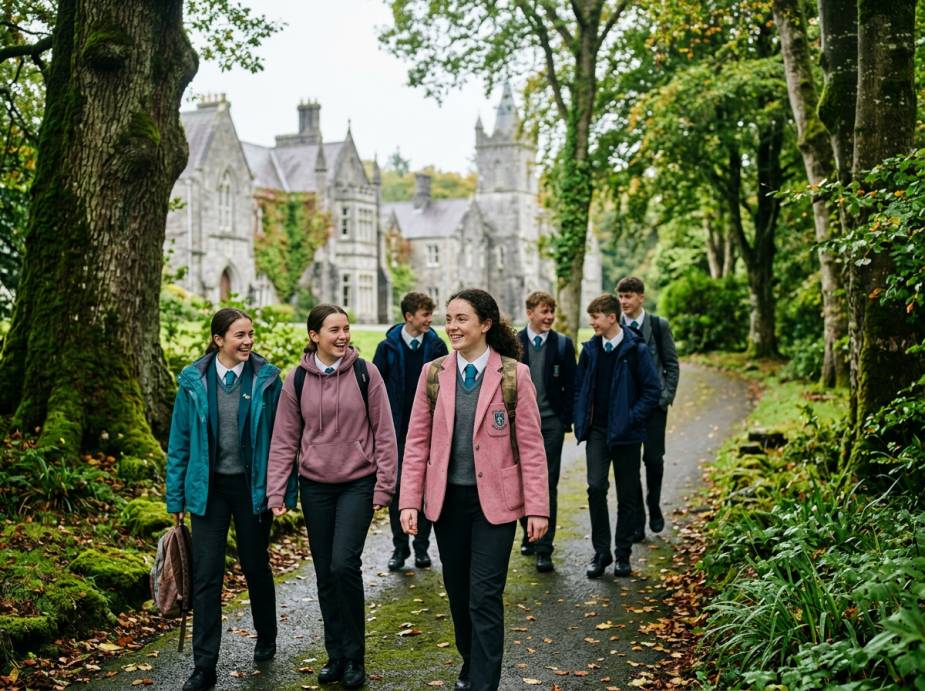
In recent years Ireland has become one of the most appealing destinations for international students, and the reasons are easy to see: it is the only English-speaking country left in the European Union after Brexit, with a mild climate, a safe environment and degrees recognised the world over. Students come here for an excellent education and an atmosphere far removed from the rush of London or Paris. This is a place to study rather than simply to live — though you live well too.
What people usually come to study
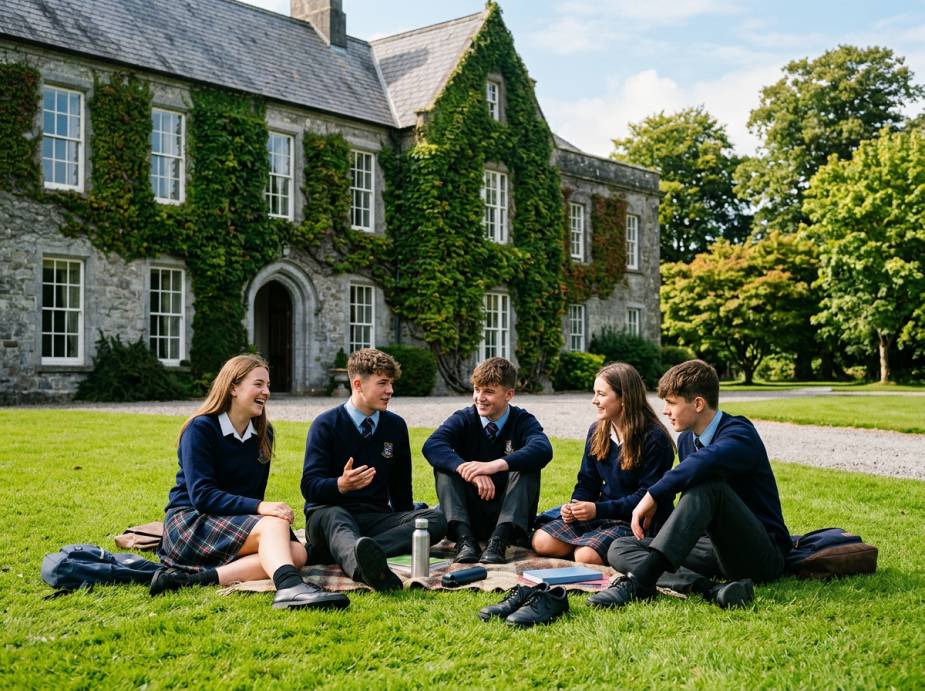
For school pupils. Irish private boarding schools are small, homely institutions. Unlike in the United Kingdom, only around 10% of schools here are private boarding schools, yet they are every bit as strong on quality and noticeably more competitive on price. Schools take children from the age of 11–12, and some from the lower years. They follow the Irish national curriculum, which culminates in the Leaving Certificate exam — a qualification recognised by many universities in the USA, Europe and the United Kingdom. Pupils live in on-campus residences for the full week or only on weekdays, staying with host families at weekends.
For university students. Some of Europe's oldest universities are based here, such as Trinity College Dublin (founded in 1592). The strongest fields are information technology (Dublin is known as «Europe's Silicon Valley» — the European headquarters of Google, Facebook and Apple are all here), pharmaceuticals and biotechnology, business and finance, and engineering. The higher education system spans universities, technological institutes and private colleges. A Bachelor's degree usually takes 3–4 years and a Master's 1–2 years.
What studying here is like
Secondary education. Irish boarding schools have a more relaxed atmosphere than their British counterparts. Classes are small, averaging 10–15 pupils, and the school day covers not only academic lessons but also sport, the arts and clubs. The residences are cosy, with informal, almost family-like relationships between pupils and house staff. The curriculum is wide-ranging, from compulsory subjects (English, mathematics, the sciences) to dozens of options including business, economics, accounting, biology, chemistry, physics, music, art, design and graphics. After lessons come sporting fixtures, music classes and trips to theatres, museums and galleries. Each year, pupils also go on overseas tours, to destinations such as the USA, France, Germany, Italy and Belgium.
Higher education. Study at Irish universities combines lectures, seminars and independent work, with strong emphasis on research and practical work — especially in the technical disciplines and the natural sciences.
Visa requirements
Citizens of non-EU countries need a student visa to study in Ireland for longer than 90 days. The process runs in several stages.
Main requirements:
- Confirmation of enrolment from an Irish educational institution
- Proof of tuition payment (or evidence of available funds)
- Proof of funds: living costs of 7,000 euros for the applicant (plus additional funds for each accompanying person)
- Medical insurance
- A certificate of no criminal record from your country of residence
- A passport valid for at least 12 months after the planned end of your studies
Cost and timing: The consular fee for a student visa is 100 euros. An application can take 8–12 weeks to process, so it is best to submit your documents 3–4 months before your studies begin. Within 90 days of arriving in Ireland you must register with the immigration service and obtain a residence permit (IRP card).
Pros and cons
Pros:
- English is the official language, which makes settling in easier.
- Irish degrees are highly regarded worldwide, especially in IT, pharmaceuticals and business.
- Tuition costs less than in the USA or the United Kingdom.
- A safe environment and a welcoming attitude towards foreigners.
- «Europe's Silicon Valley» — rare career opportunities at technology companies.
- EU membership brings certain advantages after graduation.
- A multicultural environment that never feels overcrowded.
Cons:
- An acute housing shortage, especially in Dublin, with high rents.
- A narrower choice of boarding schools than in the United Kingdom.
- The climate — windy and rainy, with barely any warm summer.
- Public transport in smaller towns is poorly developed, so a car is often needed.
- Outside Europe, Irish degrees carry less weight than those from Oxbridge or top American universities.
|
In Ireland, university evaluation is usually based on global rankings such as QS and THE, while as a local reference point, data from uniRank is often used, which ranks Irish universities based on web metrics — visibility in search engines, website traffic, and the number of external links. Although uniRank does not directly reflect academic quality, it provides insight into a university's digital visibility, which can be useful for assessing its international presence. Below is the Top 10 universities in Ireland according to uniRank 2026. For each institution, we've also included their positions in the global QS World University Rankings 2026 and THE World University Rankings 2026. QS places more weight on reputation among employers and the academic community (50% of the weighting), while THE focuses on research productivity and citation impact (59% of the weighting). Together with uniRank, these three rankings offer a multi‑faceted picture: uniRank shows online visibility, QS reflects global reputation, and THE reveals the university's research potential. |
|||
| Rank (uniRank 2026) | University | QS 2026 (World) | THE 2026 (World) |
|---|---|---|---|
| 1 | Trinity College Dublin (TCD) | 75 | 173 |
| 2 | University College Dublin (UCD) | 118 | 201–250 |
| 3 | University College Cork (UCC) | 246 | 351–400 |
| 4 | University of Galway | 284 | 351–400 |
| 5 | Dublin City University (DCU) | 410 | 301–350 |
| 6 | University of Limerick (UL) | ~401 | 501–600 |
| 7 | Technological University Dublin (TU Dublin) | 781–790 | 1201–1500 |
| 8 | Maynooth University | 771–780 | 501–600 |
| 9 | Technological University of the Shannon (TUS) | — | — |
| 10 | South East Technological University (SETU) | — | — |
|
The primary authoritative source for comparing schools is the Irish Times Feeder Schools ranking, which evaluates educational institutions based on the percentage of their graduates who go on to higher education. This ranking covers both public and private schools and is published based on data supplied by the universities themselves, making it an objective reference point for parents. Below is the Top 10 schools in Ireland according to the Irish Times Feeder Schools 2026, based on available data. The ranking shows not only academic performance but also how effectively a school prepares its students for admission to prestigious universities in Ireland and abroad — which is particularly important when choosing an educational pathway. |
||||
| Rank | School | City | County | School Type |
|---|---|---|---|---|
| 1 | Muckross College | Donnybrook | Dublin | Public (non‑fee‑paying) |
| 2 | Coláiste Íosagáin | Booterstown | Dublin | Public (Irish‑medium secondary school) |
| 3 | Scoil Chriost Ri | Portlaoise | Laois | Public |
| 4 | Presentation Secondary School | Listowel | Kerry | Public |
| 5 | Duiske College | Graignamanagh | Kilkenny | Public (co‑educational) |
| 6 | Regina Mundi College | Cork | Cork | Public (non‑fee‑paying, girls' school) |
| 7 | Maynooth Post Primary School | Maynooth | Kildare | Public (non‑fee‑paying) |
| 8 | Mount Saint Michael | Cork | Cork | Public |
| 9 | Strathearn School | Belfast | Antrim | Public (girls' school) |
| 10 | Rathmore Grammar School | Belfast | Antrim | Public |