BOARDING SCHOOLS
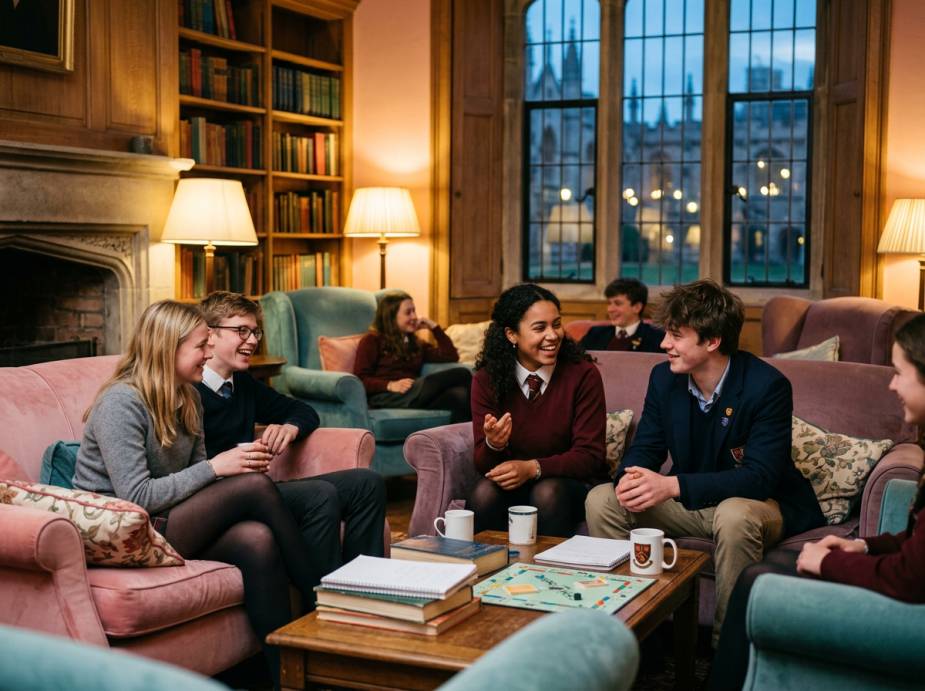
A boarding school is a place where a child not only studies but also lives — around the clock, with three meals a day, house staff and a strict timetable. It is the most popular choice for children aged 7 to 18 in secondary education abroad without their parents.
Who lives there?
Mostly children from other countries — around 30–40% of pupils at private boarding schools in Switzerland and the United Kingdom come from abroad. The largest groups are Chinese, German, Russian and Arab students. At British boarding schools the share of international pupils reaches 25%; at Swiss ones it can hit 80–90%. Parents choose this option when they want to give their child not just an education, but also discipline, accent-free English, sport and connections for the future.
What is daily life like?
Pupils live in residences known as «houses». Each house has its own name, its own colour and sometimes even its own anthem. The youngest (7–11 years old) usually share rooms of four to six, the middle group (11–14) rooms of two to four, and the oldest (14–18) get single or double rooms. Each building has a shared common room with sofas and a TV, a small kitchen with a kettle and microwave, and a laundry room. The house parents live in too — checking homework, making sure everyone goes to bed and settling quarrels. The routine is intense: up at 7 a.m., breakfast, lessons from 9 until 3 or 4, then sport or clubs, dinner, supervised prep, and lights out between 9 and 11 p.m. depending on age. At weekends there are excursions, matches and trips into town. During the long holidays (Christmas, Easter, summer) the boarding school closes, and pupils either go home or stay with host families (a separate service for an extra fee).
The upsides. Safety — the child is always supervised. Language — especially at international boarding schools (Switzerland, the United Kingdom), children speak English around the clock. Discipline — the routine teaches them to organise their time. Sport and clubs — no need to drive the child anywhere, as everything is on site. And, most importantly, the child is neither left to their own devices nor a burden on unfamiliar adults, as can happen with a host family.
The downsides. It is expensive — boarding schools cost considerably more than day schools. Separation from family — younger children can feel very homesick. Limited freedom — curfews and the rule against going out without permission frustrate teenagers. A heavy workload — combining study, sport and prep really is hard. And one more thing: at some boarding schools the relationship between pupils and house staff is very formal — less like a family, more like the army or a hotel.
What stands out in different countries
- United Kingdom. The birthplace of the boarding school. The tradition goes back several hundred years — Eton was founded in 1440, Harrow in 1572. Each house is a little world of its own, with its own traditions: dinners in gowns, cricket matches, the initiation of newcomers. House parents often live in a neighbouring flat with their own family, and the children play with their kids. Almost all British boarding schools sit in the countryside, in historic buildings. Winters are cold and hot water can be scarce — all considered character-building.
- Switzerland. Here boarding schools are all about comfort and international life. Rooms are more often single, with a private bathroom. Teaching is in three languages (English, German, French). There are ski clubs, spas and stables. International pupils are the overwhelming majority, with local children in the minority. Prices are the highest in the world. In return, the atmosphere is more relaxed than in England.
- Germany. German boarding schools (Internat) are often attached to state rather than private schools — you pay only for accommodation and meals (around 500–1,500 euros a month), which makes them more affordable. They are also more democratic: pupils take part in running the school through a parliament. Many have an environmental focus, with their own farm, vegetable garden and forest school. The rules are strict, but fair.
- USA. American boarding schools are huge campuses in the suburbs. Sport comes first: football fields, swimming pools, basketball courts. The school teams compete against other schools. Residences are often grouped by interest — a «music house», a «sports house». The house staff are usually young teachers who live on site, and the atmosphere is more informal than in Europe.
Who is it right for?
For children who are ready for discipline, want to throw themselves fully into their studies and don't mind living in an international environment. It is an excellent fit when the parents work abroad or want their child to get into a top university, and a poor one for very home-loving children who struggle to be apart from their family.
A less obvious fact. At good boarding schools the standard of education is often higher than at private day schools — simply because pupils have more time for study and prep. There is no hour-long journey home and no helping with the cooking, so all free time goes either to sport or to books. Many boarding-school leavers say they slept just five or six hours a night, but got into exactly the university they wanted.