GERMANY
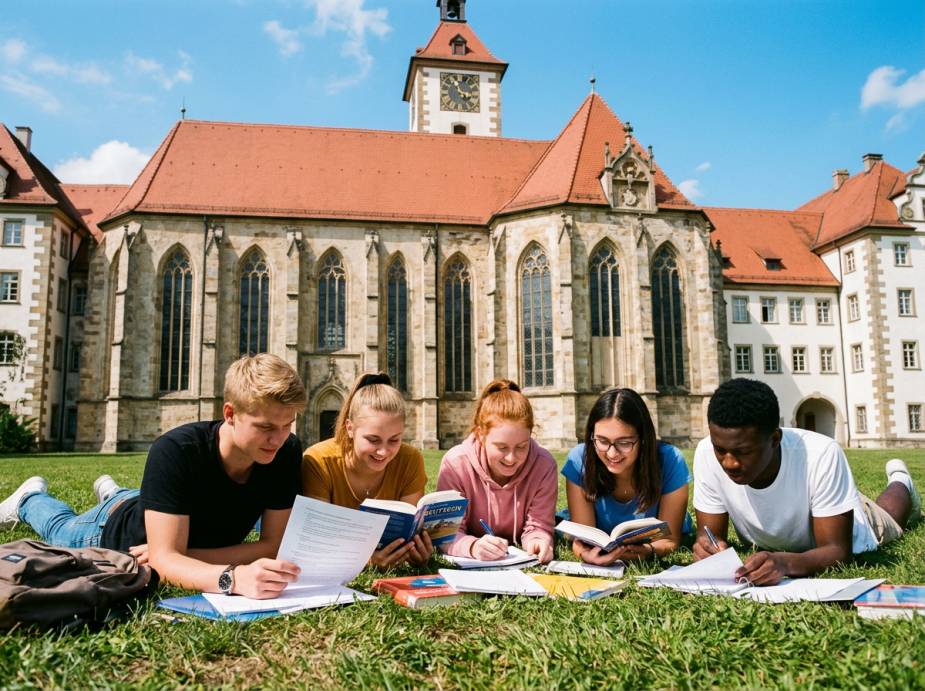
Germany is one of the few countries where a quality higher education remains within reach for most people. Public universities charge little or no tuition, and their degrees are valued worldwide. People come here for engineering, IT, the natural sciences and economics. There are pitfalls too, though: bureaucracy, the need to know German, and high financial requirements for the visa.
What people usually come to study
For school pupils. People come to Germany for an international secondary education at private boarding schools. There are around 250 of them, and they differ markedly from their British or Swiss counterparts. German boarding schools (Internat) are more often attached to state schools than to elite private ones — you pay only for accommodation and meals, which makes them more affordable. They occupy picturesque settings: castles, forests, riverbanks. Internat Schloss Bieberstein, for instance, is housed in a castle 15 km from Fulda, while Internat Solling sits in parkland on the river Weser. Pupil numbers are low — 100–200 per school — and classes are small, up to 10–12, so each child gets attention. The share of foreigners is lower than in Switzerland, though at some schools it reaches 50–80%.
For students. The main magnet is the universities. In the 2024/25 winter semester around 402,100 international students were enrolled here — 6% more than the year before. Foreigners make up 14% of all students in Germany. The number of international first-years hit an all-time high of 116,600. By region, 33% of international students come from the Asia-Pacific, 19% from North Africa and the Middle East, and 15% from Western Europe. The biggest countries of origin are India (around 59,000 students) and China. The most popular fields are engineering (43% of international students), business and economics, computer science, the natural sciences and medicine.
Features of studying
Secondary education. German boarding schools follow a clear routine: lessons, sport, clubs and self-study. The German approach is notably democratic — many schools have student self-governance, with pupils helping to make decisions through a school parliament. Many have an environmental focus, with their own farm, vegetable garden and forest school. At some, two foreign languages are compulsory. The academic year begins in August or September and is split into two semesters.
Vocational education (Ausbildung). One thing that sets Germany apart is its dual system of vocational training. Students study at a vocational college and work at a company at the same time, earning a salary. The programmes run 2–3.5 years and cover hundreds of occupations, from IT and banking to nursing and car mechanics. On completion you receive a certificate recognised throughout Germany, plus genuine work experience. Pay during training is 800–1,500 euros a month, depending on the sector. Requirements for foreigners: German at B1–B2 level, an age limit of 35, and a study visa. Finding a placement is down to the student, though dedicated support programmes exist.
Higher education. In Germany a Bachelor's degree takes 3–4 years (usually 6–7 semesters) and a Master's 1–2 years. The academic year is split into two semesters: winter (October – March) and summer (April – September). You can enter a German university either straight after school or via a Studienkolleg. For citizens of countries whose school certificate is not recognised in Germany (including Russia), the Studienkolleg is mandatory — these are 6–12-month courses ending with the Feststellungsprüfung exam. International students can earn all the standard academic degrees: Bachelor's (BA, BSc), Master's (MA, MSc) and Doctoral (PhD).

Visa requirements
- Citizens of non-EU countries need a student visa or a residence permit for study purposes. Main requirements:
- Confirmation of enrolment at a university or Studienkolleg
- Proof of funds — a blocked account of 11,904 euros
- Medical insurance
- Knowledge of German (for German-taught programmes — usually B2–C1)
- A passport valid for at least the full period of study
After arrival you register with the local foreigners' authority and obtain a residence permit (usually for 1–2 years, with the option to extend). Visa processing takes 8–12 weeks. Applications from Russian citizens are accepted, but call for particular care over the accuracy of the information and the completeness of the document set.
Pros and cons
Pros:
- Free or very cheap tuition at most universities.
- High-quality education and worldwide recognition of degrees.
- The chance to stay on after your studies and gain permanent residence.
- A wide choice of English-taught programmes, especially at Master's level.
- A strong economy and good career prospects for graduates in technical fields.
Cons:
- The need for a high level of German (for a Bachelor's degree and for everyday life).
- Bureaucracy — obtaining a visa and residence permit takes time and effort.
- A high cost of living in the big cities.
- Competition for popular fields (medicine, psychology, business).
- Few Bachelor's programmes in English, especially at public universities.
|
In the German higher education system, there is no single nationwide ranking comparable to the UK's Complete University Guide or the US's U.S. News. The most authoritative internal instrument is considered to be the CHE University Ranking (Centre for Higher Education Development), however, it does not produce a consolidated list of universities, but rather ranks specific subjects across a wide range of criteria — from student satisfaction and learning conditions to facilities and career prospects. This makes the CHE useful for in‑depth subject selection, but it does not provide a holistic picture of a university as a whole. Therefore, the basis for the national top here is the QS World University Rankings 2026 — as the most widely cited in the world and offering a comprehensive picture of all German universities, assessing them by reputation among employers and the academic community. Below is the Top 10 universities in Germany according to the QS World University Rankings 2026. For each institution, we have also included their positions in the THE World University Rankings 2026, which emphasises research productivity and citation impact, allowing universities to be assessed from different angles — global reputation and research firepower. |
|||
| Rank (QS 2026, Germany) | University | QS 2026 (World) | THE 2026 (World) |
|---|---|---|---|
| 1 | Technical University of Munich (TUM) | 22 | 27 |
| 2 | LMU Munich (Ludwig Maximilian University of Munich) | 58 | 34 |
| 3 | Heidelberg University | 80 | 49 |
| 4 | Free University of Berlin | 88 | =113 |
| 5 | Karlsruhe Institute of Technology (KIT) | 98 | 166 |
| 6 | RWTH Aachen University | 105 | =92 |
| 7 | Humboldt University of Berlin | 130 | 89 |
| 8 | Technical University of Berlin | 145 | =160 |
| 9 | University of Hamburg | 147 | =125 |
| 10 | University of Freiburg | 193 | =138 |
|
In Germany, as in Italy or France, there is no single nationwide school ranking comparable to the British one. Education falls under the jurisdiction of the federal states (Bundesländer), and each publishes its own performance data, making direct comparison of schools from different regions difficult. Nevertheless, there are two main reference points for nationwide comparison. The German School Prize (Deutscher Schulpreis) is the most authoritative federal award, presented to the best schools for innovative concepts, teaching quality, and social work — not just for academic results. In addition, regional rankings published by local media (e.g., Tagesspiegel in Berlin or Abendblatt in Hamburg) are based on average Abitur (final exam) grades and give an indication of leaders in each state. Below is a list of 10 schools nominated for the Deutscher Schulpreis 2026, which can be considered an unofficial top‑15 list of Germany's best schools, as it reflects recognition at the federal level. For each school, additional information includes its type (e.g., Gymnasium, comprehensive school) and federal state, allowing for regional context and the specifics of the education system to be taken into account. |
|||
| School | City | Federal State | School Type |
|---|---|---|---|
| Bertha‑von‑Suttner‑Schule | Mörfelden‑Walldorf | Hesse | Comprehensive school |
| Ferdinand‑von‑Steinbeis‑Schule | Tuttlingen | Baden‑Württemberg | Vocational school |
| Friedrich‑von‑Bodelschwingh‑Schule | Bergkamen | North Rhine‑Westphalia | Comprehensive school |
| Gemeinschaftsgrundschule Fröndenberg | Fröndenberg | North Rhine‑Westphalia | Primary school |
| Georg‑Christoph‑Lichtenberg‑Oberstufengymnasium | Bruchköbel | Hesse | Upper secondary school (Gymnasium) |
| Hans‑Carossa‑Grundschule Heining‑Schalding | Passau | Bavaria | Primary school |
| Hans‑Leipelt‑Schule | Donauwörth | Bavaria | Vocational school |
| Heinrich‑Schickhardt‑Gemeinschaftsschule | Bad Boll | Baden‑Württemberg | Comprehensive school |
| Käthe‑Kollwitz‑Gymnasium | Berlin | Berlin | Academic secondary school (Gymnasium) |
| Kurt‑Huber‑Schule | Grafenau | Bavaria | Special needs school |