THE NETHERLANDS
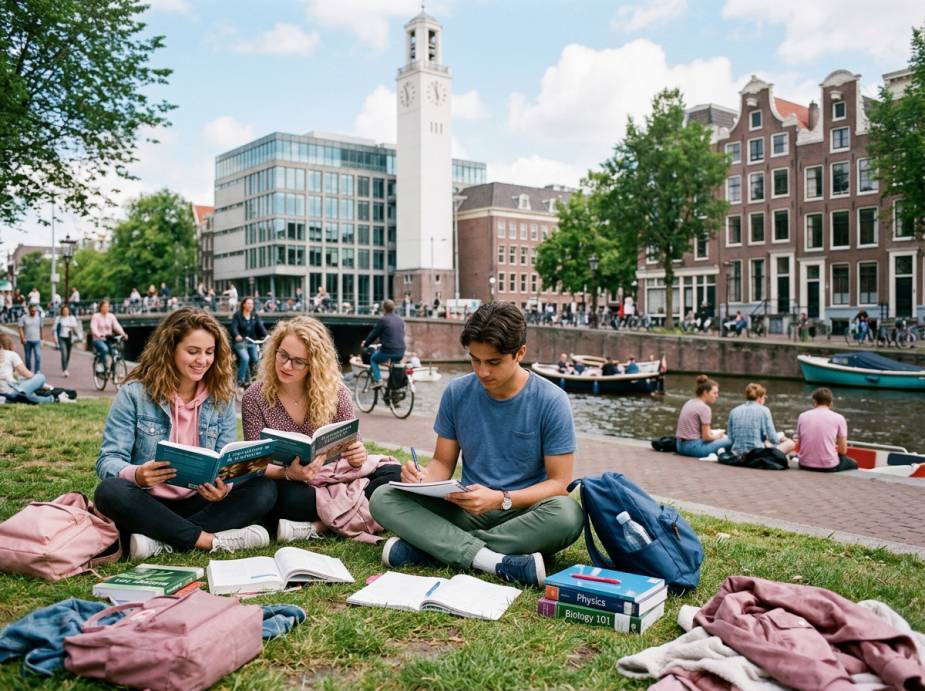
In recent years the Netherlands has become one of Europe’s biggest draws for international students, and the reasons are clear: a vast choice of English-taught programmes, comparatively affordable tuition, a strong economy and a central location in the heart of Europe. Students come here for a practical education that leads quickly to a job, rather than for the centuries-old traditions of Britain. Almost everyone speaks English too, so the language barrier is minimal even on the street.
What people usually come to study
For school pupils. Unlike the United Kingdom or Switzerland, the Netherlands is not a country of boarding schools. It has just one true international boarding school — Eerde International Boarding School. Set in the town of Ommen in the east of the country, it occupies a 17th-century manor estate. The school takes pupils from the age of 12, with around 150 children from 20 countries studying there at any one time. You can choose full boarding (the child lives on campus), weekly boarding (going home at weekends) or day school. A year of tuition with accommodation costs around 21,700 euros plus a registration fee. The programmes are built around the International General Certificate of Secondary Education (IGCSE), which every Dutch university recognises. The arts are a particular strength: the school has its own art gallery, a theatre studio and a music school.
For students. Far more international students come for higher education. In the 2024/25 academic year there were 115,000 international students at Dutch universities and universities of applied sciences, 37,600 of them in their first year. The most popular fields are business, economics, IT, engineering and the social sciences. The international share is especially high on Master’s programmes: at the University of Twente, for instance, 72% of Master’s students come from abroad. The Netherlands is also renowned for its universities of applied sciences (hogescholen), which train people for specific professions, from engineering to the arts. Employers abroad value these graduates for their readiness to get straight down to work.
How studying works
Secondary education. Dutch schools are infused with pragmatism and freedom. You rarely see a strict uniform, everyone is on first-name terms, and teachers do not lean on their authority. In place of rote learning come projects and discussion. Teaching is in Dutch or English. Most schools are state-run and free, but to enrol an international pupil without residence rights you need a study permit, which is not granted to everyone.
Higher education. There are two very different types of university. Research universities (WO) provide fundamental knowledge; their Bachelor’s lasts three years and the Master’s one to two. Universities of applied sciences (HBO) focus on practice, and there the Bachelor’s lasts four years. Both offer hundreds of programmes in English.
Studying in the Netherlands is known for its intensity. Students do a great deal of independent work: reading, essays and group projects. In return, they come away highly self-organised and with a modern outlook.
Visa requirements
Citizens of non-EU countries studying for longer than 90 days need a temporary residence permit (MVV) and a residence permit. The process works like this: once you are admitted, the university itself submits your documents to the Immigration Service (IND). You receive an MVV to enter the country and, on arrival, a residence permit for the duration of your studies. The main requirements are:
- A passport valid for at least your whole period of study
- Confirmation of enrolment
- Proof of finances: around 13,200 euros a year for living costs
- Health insurance
- Sometimes — a certificate of no criminal record
The consular fee when applying at the embassy is around 210–350 euros, depending on the country.
One key advantage: a student visa lets you travel freely throughout the Schengen Area, and graduates may stay for a year to look for work under a special scheme.
Pros and cons
Pros.
- A vast choice of English-taught programmes — one of the widest in continental Europe
- Tuition costs noticeably less than in the USA or the United Kingdom
- A high quality of life and near-universal English among the locals
- Degrees are valued worldwide, especially in business and engineering
- A convenient location in the heart of Europe
- A welcoming immigration policy — a full year to find work after you graduate
Cons.
- An acute housing shortage, especially in the big cities
- The weather — rainy and windy, not for everyone
- Bureaucracy in obtaining permits is still a factor
- The system gives a broad outlook, but some say it lacks depth
- A high risk of being expelled for poor results
|
The basis for the national ranking in the Netherlands is the Times Higher Education (THE) Netherlands Ranking 2026, which ranks the country's universities based on their global performance in teaching, research environment, research quality, international outlook, and industry income. Unlike the global version of THE, the national ranking focuses on comparing universities within a single country, using the same methodology but in a local context. Below is the Top 10 universities in the Netherlands according to the THE Netherlands Ranking 2026. For each institution, we’ve also included their positions in the global QS World University Rankings 2026 and THE World University Rankings 2026. QS places more weight on reputation among employers and the academic community (50% of the weighting), while the global THE focuses on research output: 59% of the weight is given to research quality and the research environment. Together, the three rankings offer a well‑rounded picture: the national THE shows where a university stands within the Dutch system, QS reflects its perception on the global job market, and the global THE reveals its research firepower and scholarly potential. |
|||
| Rank (THE Netherlands 2026) | University | QS 2026 (World) | THE 2026 (World) |
|---|---|---|---|
| 1 | Delft University of Technology (TU Delft) | 47 | 57 |
| 2 | University of Amsterdam | 53 | =62 |
| 3 | Wageningen University & Research | ~110–120 | 66 |
| 4 | Leiden University | ~147 | =70 |
| 5 | University of Groningen | ~239 | 82 |
| 6 | Erasmus University Rotterdam | ~140 | 107 |
| 7 | Maastricht University | ~239 | =131 |
| 8 | Radboud University (Nijmegen) | ~279 | =154 |
| 9 | VU Amsterdam (Vrije Universiteit Amsterdam) | ~280–300 | =176 |
| 10 | University of Twente | ~500–550 | =190 |
|
In the Netherlands, schools are evaluated by the Education Inspectorate (Onderwijsinspectie), which assesses teaching quality, safety, and compliance with standards. However, the results of these inspections are published as reports rather than consolidated ranking tables. This reflects the Dutch education system's emphasis on an individual approach to each school, rather than comparing them against one another. Nevertheless, there are reputable independent rankings and guides that help compare schools. The international ranking International School Advisor (ISA) evaluates schools based on parent reviews, programme quality, and international recognition — which is particularly relevant for private and international schools. Meanwhile, the platform Scholen op de kaart — an official government website for comparing schools — provides objective data on academic performance, exam results, and student satisfaction, making it a reliable reference for parents. Below is the Top 10 secondary schools in the Netherlands, compiled on the basis of the ISA rankings for 2026 and data from Scholen op de kaart. |
||||
| Rank | School | City | Province | School Type |
|---|---|---|---|---|
| 1 | International School of Amsterdam (ISA) | Amstelveen (Amsterdam) | North Holland | Private international school |
| 2 | The British School of Amsterdam (BSA) | Amsterdam | North Holland | Private international school |
| 3 | International School of The Hague (ISH) | The Hague | South Holland | Private international school |
| 4 | Vossius Gymnasium | Amsterdam | North Holland | Public classical grammar school |
| 5 | Praedinius Gymnasium | Groningen | Groningen | Public classical grammar school |
| 6 | Stedelijk Gymnasium Leeuwarden | Leeuwarden | Friesland | Public classical grammar school |
| 7 | Rotterdam International Secondary School (RISS) | Rotterdam | South Holland | Public international school |
| 8 | Amsterdam International Community School (AICS) | Amsterdam | North Holland | Public international school |
| 9 | Johan de Witt Scholengroep | The Hague | South Holland | Public secondary school |
| 10 | Murmellius Gymnasium | Alkmaar | North Holland | Public classical grammar school |