SWITZERLAND
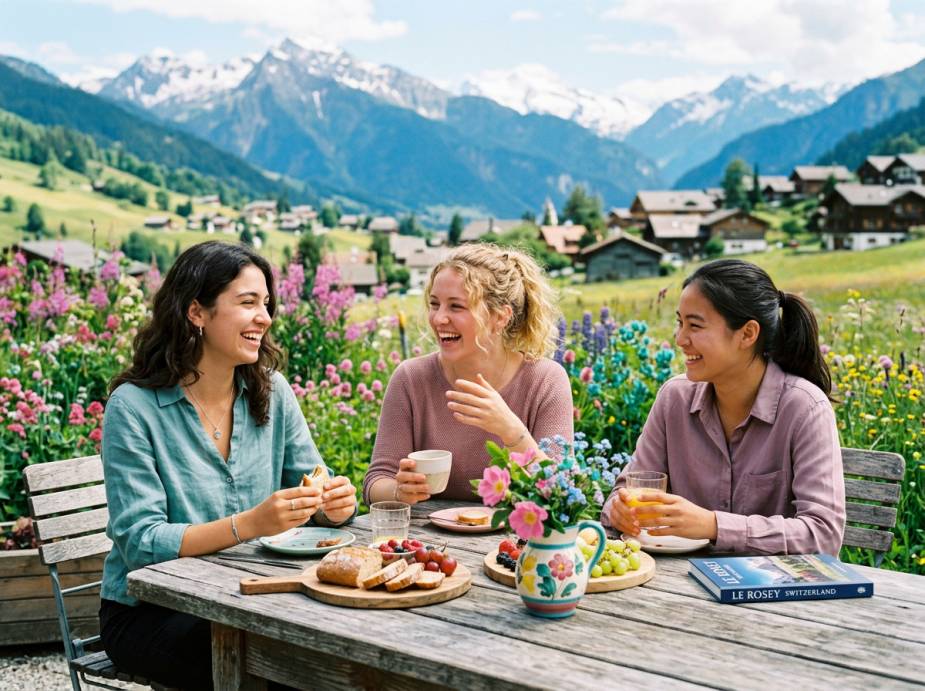
Switzerland is a country where education is very expensive — but the quality lives up to the price. Families come for elite secondary education at private boarding schools, counted among the best in the world, and for higher education in hospitality management, finance and technology. Public universities, by contrast, cost little even for international students: here the main outlay is not tuition but living costs.
What people come to study
For school pupils. Swiss private boarding schools are the absolute elite. International pupils make up as much as 98% of the roll, with local students no more than 2%. Each year around 100,000 children from abroad take their secondary education at Swiss boarding schools, drawn from royal families and the worlds of business and politics across the globe. Lessons may be taught in German, French, Italian or English, and graduates leave with the Swiss Matura (which opens any Swiss university), British A-Levels or the American High School Diploma. Many parents choose Swiss schools for the multilingual setting and the very highest standards of comfort and safety.
For students. Swiss universities are renowned for their technical disciplines, business education and, of course, hospitality management — the country’s calling card. Public universities enrol around 258,000 students, up to 30% of them from abroad. Particularly sought after are ETH Zurich (the Swiss Federal Institute of Technology), the University of Lausanne (UNIL) and the University of St. Gallen (a business school). Hospitality management is taught at private schools such as EHL (Ecole hôtelière de Lausanne), regularly rated the best in the world.
What studying here is like
Secondary education. Switzerland’s signature feature is multilingualism: you can study in German, French, Italian or English. The schools occupy beautiful settings — at the foot of the Alps, on the shores of Lake Geneva, high in the mountains. The day is full: lessons, sport, the arts and supervised prep. Sport is a particular focus — skiing, tennis, riding, swimming and mountain hikes — and some lessons even take place outdoors. Classes are small, often 6–12 pupils, so teachers can work with each one individually.
Higher education. Switzerland has two types of university: classical universities (theory and science) and universities of applied sciences (practice and close links with industry). A Bachelor’s usually takes 3 years and a Master’s 1.5–2. One distinctive touch: at some universities students start working in their field well before they graduate. Swiss degrees are recognised worldwide, and ETH Zurich is consistently among the global top 10 for engineering and the natural sciences.
Visa requirements
Citizens of non-EU countries need a study visa (National Visa – type D). It lets you enter the country, after which you obtain a residence permit on arrival (Permis de séjour).
Main requirements:
- Confirmation of enrolment from a Swiss educational institution
- Proof of funds (usually 21,000+ francs for the first year)
- Health insurance (Swiss cover can be arranged after arrival, but proof is sometimes required for the visa)
- A passport valid for a sufficient period
- Educational documents (school certificate, diploma with an apostille or translation)
Timing: apply 2–3 months before your studies begin. Processing can take 8–12 weeks. The consular fee for Russian citizens is around 135–150 euros (paid in Swiss francs).
The pros and cons
Pros:
- The highest standard of living — Switzerland is one of the safest and cleanest countries in the world.
- A multilingual setting — you can study and live in several languages.
- Public universities are cheap even for international students (500–2,000 francs a year).
- Degrees valued everywhere, especially in engineering, finance and hospitality.
- The natural setting — the Alps, the lakes, the clean air.
- Swiss boarding schools offer wonderfully comfortable conditions: cosy rooms (often single, with an en-suite bathroom), excellent food and genuine care for the children.
Cons:
- Admission to public universities is far from easy: you need a school certificate recognised by the Swiss authorities, high grades and command of the language of instruction (German, French or Italian).
- International graduates struggle to find work without an offer from a local employer, and only 6 months are allowed for the search.
- Bureaucracy and expensive, compulsory health insurance.
- In 2025–2026 some universities raised their fees for international students (ETH Zurich among them), and others may well follow.
|
To compile the ranking of Swiss universities presented below, the authoritative Times Higher Education (THE) World University Rankings 2026 was used as the basis, which ranks Swiss universities based on their global performance in teaching, research environment, research quality, international outlook, and industry income. Below is the Top 10 Swiss universities according to the THE World University Rankings 2026. For each institution, we’ve also included their positions in the global QS World University Rankings 2026 and THE World University Rankings 2026. There is no separate national ranking in Switzerland, like the UK's The Complete University Guide or the US's U.S. News. This is due to the small number of institutions (only 12 universities), which makes a separate national ranking system less relevant. Swiss universities are traditionally internationally oriented, so performance in global rankings (THE, QS) serves as the primary benchmark — used by the universities themselves and by government bodies, including the State Secretariat for Education, Research and Innovation (SBFI). |
|||
| Rank (THE 2026, Switzerland) | University | QS 2026 (World) | THE 2026 (World) |
|---|---|---|---|
| 1 | ETH Zurich (Swiss Federal Institute of Technology Zurich) | 7 | 11 |
| 2 | EPFL (Swiss Federal Institute of Technology Lausanne) | =22 | 35 |
| 3 | University of Bern | =184 | 108 |
| 4 | University of Basel | 158 | 120 |
| 5 | University of Lausanne | =212 | 125 |
| 6 | University of Geneva | =155 | 166 |
| 7 | Università della Svizzera italiana (USI) | =473 | 251–300 |
| 8 | University of St. Gallen | ~600–650 | 351–400 |
| 9 | University of Fribourg | 642 | 401–500 |
| 10 | University of Neuchâtel | ~800–1000 | 601–800 |
|
In Switzerland, as with universities, there is no single national ranking of secondary schools. The reason lies in the country's federal structure: education falls under the jurisdiction of the cantons, and there is simply no unified nationwide system for assessing and ranking schools. Each canton sets its own standards and criteria, so nationwide lists of the best schools do not exist. Most available rankings are compiled for private boarding schools, which cater to international students and are interested in global recognition. Such rankings are published by educational portals and are sometimes included in lists of the world's most expensive schools. Swiss public schools, by contrast, do not participate in such rankings, although many of them offer a high standard of education. Below is the Top 10 most prestigious and renowned private schools in Switzerland, compiled based on data from the sources mentioned above. |
||
| Rank | School | Location |
|---|---|---|
| 1 | Institut Le Rosey | Rolle / Gstaad |
| 2 | Institut auf dem Rosenberg | St. Gallen |
| 3 | Collège Alpin Beau Soleil | Villars‑sur‑Ollon |
| 4 | Aiglon College | Villars‑sur‑Ollon |
| 5 | Leysin American School | Leysin |
| 6 | St. George's International School | Montreux |
| 7 | Collège du Léman | Versoix (Geneva) |
| 8 | Lyceum Alpinum Zuoz | Zuoz |
| 9 | Brillantmont International School | Lausanne |
| 10 | Institut Monte Rosa | Montreux |