UNITED KINGDOM
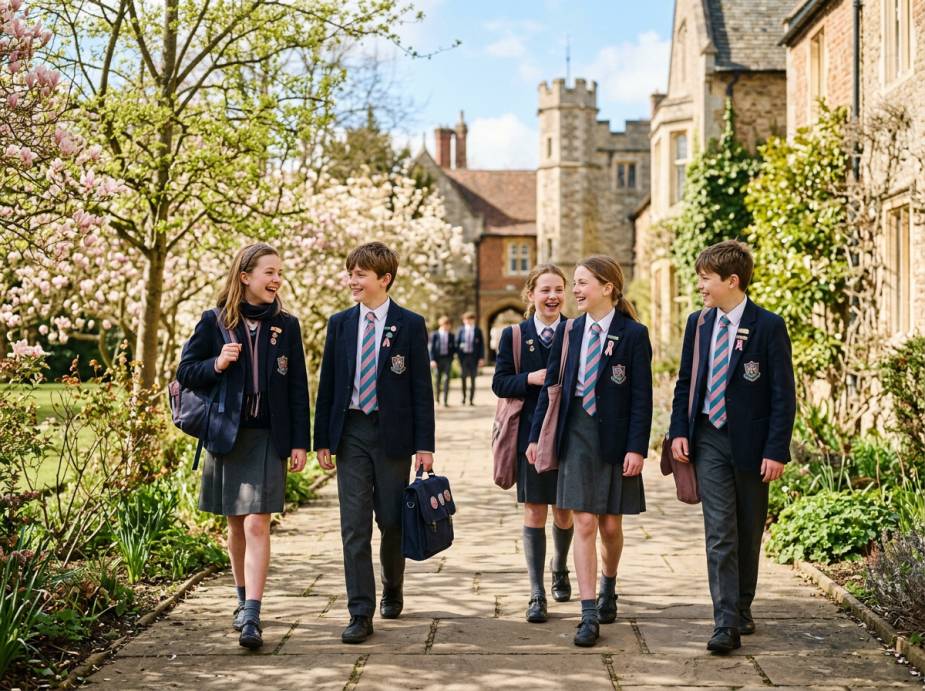
The United Kingdom is more than a country of rich tradition; it is the architect of the modern education system. Families come here for the classical excellence of private boarding schools, to perfect their academic English and to earn degrees respected the world over. To study in the UK is to choose a quality that has held its reputation for centuries.
What people come to study
For school pupils. British private boarding schools are the gold standard of secondary education, and generations of leading politicians, writers and scholars passed through them. According to the Independent Schools Council (ISC), in 2025 private schools taught 24,827 pupils whose parents live abroad (with a further 36,513 non-British pupils who are the children of UK residents). The vast majority of overseas pupils opt for full boarding (93%). UK schools have always drawn the keenest interest from China (10,959 pupils), the Middle East and Europe.
For university students. British universities remain a magnet for students from overseas. In the 2024/25 academic year, 685,565 international students were enrolled in the UK. Although that figure is down 6.1% on the peak of 2022/23, following changes to immigration policy, the country's appeal is undimmed. China and India send the most students, and recruitment from China is climbing again after a slight dip. The most popular choices are Master's programmes and research in business, law, engineering and artificial intelligence.
What studying here is like
Secondary education. The system is admirably clear. Compulsory secondary education ends with GCSE exams at the age of 16, after which the route to university runs through A-levels (the British standard) or the International Baccalaureate, which is recognised worldwide. Boarding schools offer an atmosphere of classical education: a strict dress code, residences with house parents, a rich sporting life and teaching in small classes. The academic year begins in September, and the UK has more than 500 private boarding schools set across the picturesque countryside.
Foundation programmes. This is the bridge between school and university, and it is ideal for international students whose 11 years of schooling do not match the British 13. The programme runs for a year and combines intensive English with core subjects (business, engineering, IT). Almost every major university has its own International College offering these programmes, with a guaranteed first-year place on successful completion. A year of study, at Bournemouth University for example, costs around £18 700 – £19 700.
Higher education. A UK education is known for its intensity and compact timescale. A Bachelor's degree takes just 3 years (except in Scotland) and a Master's only 1, so you save considerably on living costs and start your career sooner. The Russell Group is the elite of British higher education, bringing together Oxford, Cambridge, Imperial College London and other leading universities at the top of the global rankings.

Visa requirements
To study in the United Kingdom on courses lasting longer than 6 months, you need a Student Route Visa.
The main requirements are: a Confirmation of Acceptance for Studies (CAS) from a licensed institution; proof of English language proficiency (SELT); and proof of funds (enough to cover tuition plus a minimum of £1 171 a month for living costs outside London).
IHS (Immigration Health Surcharge): a compulsory contribution of £776 a year for access to the UK's NHS (paid with the visa for the full duration of your studies).
Timing and cost: you can apply up to 6 months before your course begins. The visa costs around £524 on top of the IHS payment.
The pros and cons of studying here
Pros:
- A world-class degree that opens doors anywhere on the planet.
- The world's oldest universities and the strongest academic tradition.
- Short programmes, so you recoup your investment faster.
- The right to 2–3 years' work after graduation.
- A vast, multicultural community and excellent networking.
Cons:
- Very expensive, especially in London and at the top private schools.
- Visa and financial requirements are tightening, which adds bureaucratic hurdles.
- Rising living costs and pricier services (the IHS among them) are making the country less affordable.
- Studying in London calls for real self-discipline, given the distractions of a major city.
|
Below is the Top 10 UK universities according to the national Complete University Guide 2026. For each institution, we’ve also included their positions in the global QS World University Rankings 2026 and THE World University Rankings 2026. Both rankings assess universities, but from different angles: QS places more weight on reputation among employers and the academic community, while THE focuses on research output and citation impact. Broadly speaking, QS gives you a better sense of how a university is perceived in the job market, whereas THE reflects its research firepower. Together, they offer a fuller picture than either one alone. |
|||
| Rank (CUG 2026) | University | QS 2026 (World) | THE 2026 (World) |
|---|---|---|---|
| 1 | University of Cambridge | 6 | =3 |
| 2 | University of Oxford | 4 | 1 |
| 3 | London School of Economics (LSE) | 56 | 52 |
| 4 | University of St Andrews | ~100 | ~100 |
| 5 | Durham University | 94 | ~80–90 |
| 6 | Imperial College London | 2 | 8 |
| 7 | Loughborough University | ~200 | ~200 |
| 8 | University of Bath | ~150 | ~150 |
| 9 | University of Warwick | 74 | ~122 |
| 10 | Lancaster University | ~150 | ~150 |
| For secondary education in the UK, there is no single official national ranking. However, the most authoritative and widely trusted guide among parents is The Sunday Times Parent Power Guide. This ranking assesses schools exclusively on GCSE and A‑Level results — specifically, the percentage of top grades achieved — making it a direct indicator of academic performance. Below is the Top 10 UK schools according to this ranking. | |||
| Rank | School | City/Town | School Type |
|---|---|---|---|
| 1 | St Paul's School | London | Independent boys' school |
| 2 | Brighton College | Brighton | Independent co‑educational school |
| 3 | North London Collegiate School | London | Independent girls' school |
| 4 | The Godolphin and Latymer School | London | Independent girls' school |
| 5 | Guildford High School | Guildford | Independent girls' school |
| 6* | Queen Elizabeth's School, Barnet | London | State grammar school |
| 6* | St Paul's Girls' School | London | Independent girls' school |
| 8 | King's College School, Wimbledon | London | Independent boys' school |
| 9 | Westminster School | London | Independent co‑educational school |
| 10 | Wilson's School | Wallington | State grammar school |